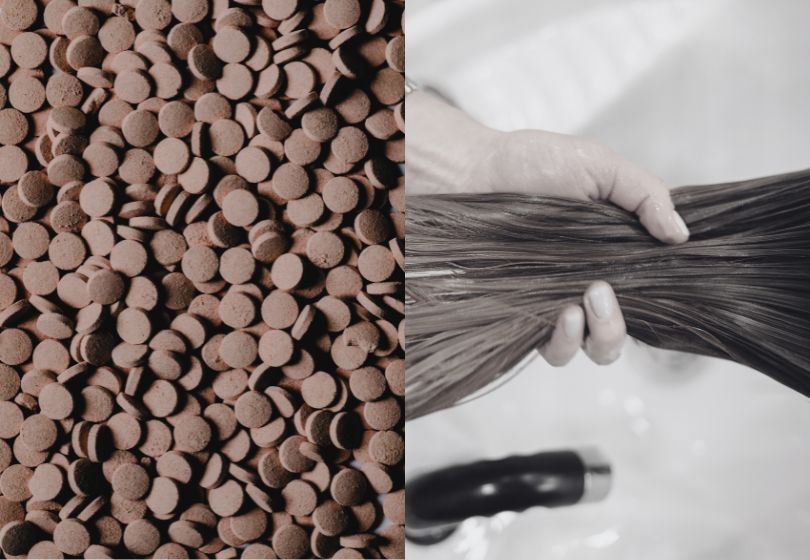
Hair and nails are made almost entirely of keratin, so a keratin supplement sounds like the most logical product on the shelf. Give your body the thing your hair is made of. The problem is that keratin is one of the hardest proteins to digest, and most keratin supplements are built from sources your body cannot use.
The short answer
Ordinary keratin, the kind taken from feathers, hooves, or horns, is not soluble and is very difficult to digest, so a supplement made from it is unlikely to do much. One specific processed form, sold as solubilized keratin, was created to solve this, and it does have a controlled trial behind it showing better hair strength and less nail breakage over 90 days. That trial was small and run with the ingredient maker involved, so the evidence is real but limited. What you are buying matters more here than with almost any other supplement.
Why keratin is hard to digest
Keratin is what makes hair, nails, and the outer layer of skin tough. That toughness comes from an amino acid called cysteine, which forms strong sulfur bonds that hold the protein together. Those same bonds are what make keratin resistant to digestive enzymes.
There is a simple way to picture it. Drop a strand of hair into a glass of water and it will sit there unchanged. That is keratin doing its job. The protein is built to survive, and your gut struggles with it for the same reason.
Traditional keratin supplements are made from animal horns, hooves, wool, or feathers. Since that keratin is insoluble, taking it is unlikely to deliver anything useful to your hair or nails.
The processed version, and what it found
To get around this, manufacturers developed solubilized keratin, where the sulfur bonds are broken gently so the protein becomes digestible while staying intact. The best-known version is made from New Zealand sheep wool and sold under the name Cynatine HNS.
This form has been tested. In a 90-day trial, 50 women were split into two groups. One took 500 mg of solubilized keratin daily, the other took a placebo. The keratin group showed statistically significant improvements in hair strength, hair loss during washing, and the tendency of nails to break. The researchers also measured amino acid changes in the hair itself, which suggested the keratin was being absorbed.
A separate 2025 trial tested a different processed form, a keratin hydrolysate made from poultry feathers, at 500 or 1000 mg a day for 90 days in women with visible signs of skin ageing.
Where the evidence runs thin
Both trials share the same weaknesses, and they are worth knowing before you spend anything.
The main study included 50 people, which is small. It ran for 90 days, so nothing is known about longer use. And it was conducted with the involvement of the company that makes the ingredient. That pattern turns up constantly in supplement research, and it does not make results invalid, but industry-funded trials tend to report more favourable outcomes than independent ones. Nobody has repeated this work independently at a larger scale.
There is also a practical problem. Most keratin supplements on the shelf do not use the processed form. If a label just says keratin without naming a specific solubilized or hydrolysed version, you are most likely buying the indigestible kind.
How it compares to collagen
The two get sold side by side, and they are different proteins doing different jobs. Collagen sits in the deeper layer of your skin and in connective tissue. Keratin is the structural protein in hair and nails themselves. Collagen has a larger body of research behind it, including trials from more than one research group, while keratin rests on a couple of small industry-linked studies. Our guide on collagen for hair and nails covers what the collagen research shows.
The bottom line
Keratin supplements are a case where the logic is stronger than the product. Your hair is made of keratin, but keratin is built to resist digestion, so the ordinary versions sold from feathers and hooves are unlikely to help. The solubilized form has a genuine controlled trial showing stronger hair and less nail breakage at 500 mg a day over 90 days, and that is more than many beauty supplements can show. It is also one small study with the ingredient maker involved. If you want to try it, check that the label names a specific solubilized or hydrolysed keratin rather than just keratin, expect a modest effect, and give it three months. For how keratin fits alongside the other ingredients in these products, see our guide on hair, skin and nails supplements.
Questions people ask
Does taking keratin help your hair?
Ordinary keratin is very hard to digest, so it probably does little. A processed form called solubilized keratin has one controlled trial showing improved hair strength and less shedding during washing at 500 mg a day.
Why can’t your body absorb keratin?
Keratin is held together by strong sulfur bonds from the amino acid cysteine. Those bonds make it tough, which is useful in hair and nails, and they also make it resistant to digestive enzymes.
How much keratin should I take?
The trial that showed a benefit used 500 mg of solubilized keratin a day for 90 days. There is no evidence that more works better.
Is keratin better than collagen?
They are different proteins. Collagen has a larger and more varied body of research. Keratin has fewer studies, and the main one was small and industry-linked.
References
Beer C, Wood S, Veghte RH. A Clinical Trial to Investigate the Effect of Cynatine HNS on Hair and Nail Parameters. The Scientific World Journal. 2014;2014:641723. https://pmc.ncbi.nlm.nih.gov/articles/PMC4214097/
The Effects of an Oral Supplementation of a Natural Keratin Hydrolysate on Skin Aging: A Randomized, Double-Blind, Placebo-Controlled Clinical Study in Healthy Women. 2025. https://pmc.ncbi.nlm.nih.gov/articles/PMC11743286/
This article is for information only and is not medical advice. Supplements are not meant to diagnose, treat, cure, or prevent any illness. Talk to your doctor before starting anything new, especially if you are pregnant, breastfeeding, or taking medication.

Leave a Reply