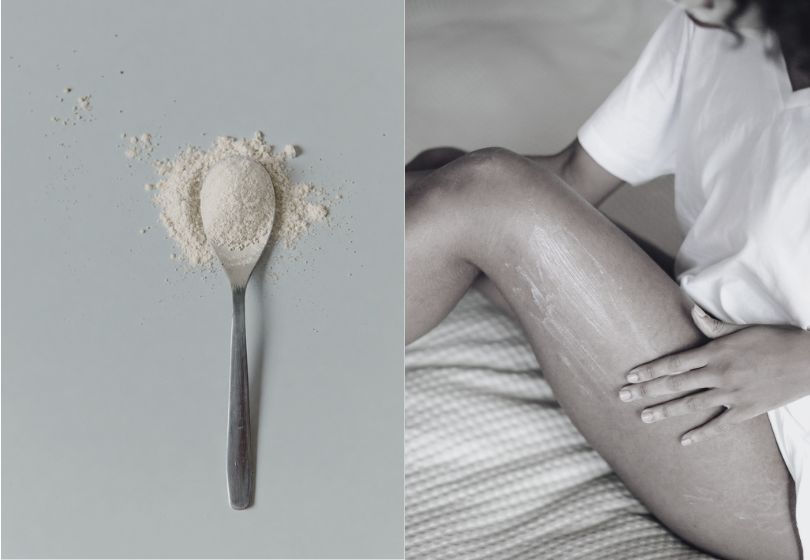
Cellulite affects most women, and the market for treatments is full of creams and supplements with little evidence. Collagen is one of the few with an actual trial behind it. The result is real but modest, and it comes with the same caveat as much collagen research.
The short answer
A controlled trial found that collagen peptides reduced the appearance of cellulite in women over six months, at a dose of 2.5 grams a day. The effect was statistically significant but visually modest, and it was stronger in normal-weight women than in those with a higher body weight. The main study was funded by a collagen maker, which is a familiar limitation in this field. Collagen is one of the better-supported cellulite supplements, on a low bar, and it is not a cure.
Why collagen might affect cellulite
Cellulite is a structural issue rather than a fat problem. It happens when fat pushes up against the connective tissue under the skin, creating the dimpled surface, and weaker or thinner connective tissue makes it more visible. That connective tissue is largely collagen, and its structure tends to weaken with age. The reasoning behind collagen supplements is that supplying collagen peptides may support the dermis and the connective tissue, firming the surface. It is a plausible mechanism, and unlike many cellulite claims, it has been tested.
What the study found
The main evidence is a 2015 trial. It gave 105 women aged 24 to 50 with moderate cellulite either 2.5 grams of specific collagen peptides a day or a placebo, for six months. The collagen group showed a statistically significant reduction in the degree of cellulite and in skin waviness on the thighs, along with improved dermal density, compared with placebo. The measured improvement in skin waviness was around 9 percent in normal-weight women.
Two things put the result in proportion. The effect, while statistically significant, was modest in visible terms rather than dramatic. And it was clearer in normal-weight women than in those with a higher body weight, where connective tissue is under more strain.
The caveat
The study has the same limitation that runs through much collagen research: it was funded and run by a collagen manufacturer. That does not make the result invalid, and it was a properly designed placebo-controlled trial, but industry-funded studies tend to report more favourable outcomes, and independent replication is limited. The honest summary is that the evidence is real and direct, but it rests largely on one industry-linked study, so confidence should stay measured. Our guide on whether collagen supplements actually work covers this pattern across collagen research.
The bottom line
Collagen is one of the few cellulite supplements with a genuine trial behind it, and that trial found a modest, real reduction in cellulite appearance over six months at 2.5 grams a day, more so in normal-weight women. It is not a cure, the effect is subtle, and the evidence leans on a single industry-funded study. If you want to try it, the dose to look for is 2.5 grams a day, and it takes months rather than weeks. Keep expectations modest, since cellulite is structural and shaped by genetics, and no supplement removes it. For the wider picture on collagen and skin, see our guide on collagen for wrinkles.
Questions people ask
Does collagen get rid of cellulite?
No supplement removes cellulite. A trial found collagen modestly reduced its appearance over six months at 2.5 grams a day, but the effect was subtle, not a cure.
How much collagen should I take for cellulite?
The study that found a benefit used 2.5 grams of collagen peptides a day for six months. More has not been shown to work better.
How long does collagen take to work on cellulite?
The trial measured improvements at three and six months. As with other collagen effects, it takes months of daily use, not weeks.
Is the evidence for collagen and cellulite strong?
It is direct but limited. The main trial was well designed but funded by a collagen maker, and independent replication is lacking, so confidence should stay measured.
References
Schunck M, Zague V, Oesser S, Proksch E. Dietary Supplementation with Specific Collagen Peptides Has a Body Mass Index-Dependent Beneficial Effect on Cellulite Morphology. Journal of Medicinal Food. 2015;18(12):1340-1348. https://pubmed.ncbi.nlm.nih.gov/26561784/
Choi FD, Sung CT, Juhasz ML, Mesinkovska NA. Oral Collagen Supplementation: A Systematic Review of Dermatological Applications. Journal of Drugs in Dermatology. 2019;18(1):9-16. https://pubmed.ncbi.nlm.nih.gov/30681787/
This article is for information only and is not medical advice. Supplements are not meant to diagnose, treat, cure, or prevent any illness. Talk to your doctor before starting anything new, especially if you are pregnant, breastfeeding, or taking medication.

Leave a Reply