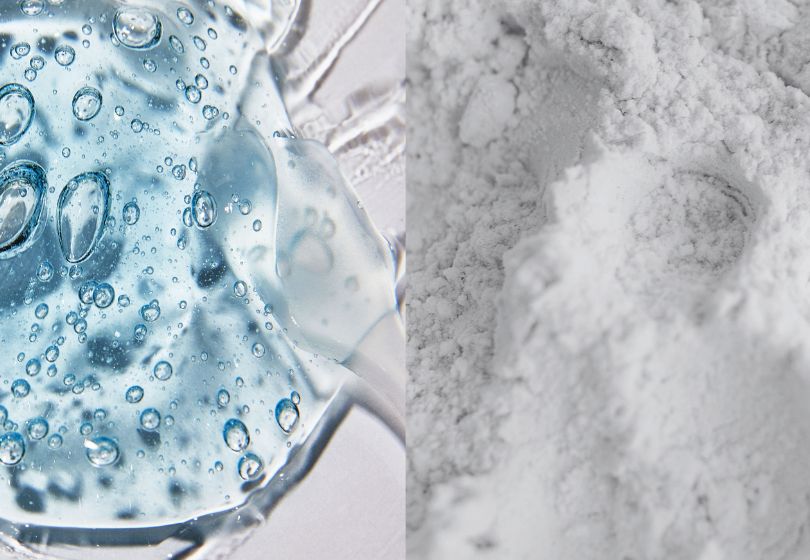
Hyaluronic acid and collagen are the two most common supplements taken for skin, and they are often compared directly. They work in different ways and have separate bodies of evidence. Neither produces dramatic change, but each has a reasonable case for specific goals, and the comparison comes down to what they do and how consistent the research is.
The short answer
Collagen is a structural protein that the skin uses in its deeper layers, and supplements show modest, reasonably consistent benefits for hydration and elasticity. Hyaluronic acid is a molecule that binds water in the skin, and oral supplements have trial evidence for improved hydration. Their strongest overlap is skin moisture, where both have support. Collagen has the wider remit, since it also has evidence for nails, while hyaluronic acid is focused on skin. Both require consistent use over weeks, and both are modest rather than transformative.
What each one does
Collagen and hyaluronic acid occupy different roles in skin. Collagen is the main structural protein in the dermis, the layer beneath the surface, and it gives skin its firmness. The body’s own collagen declines with age. Hyaluronic acid sits alongside it and acts as the skin’s water-binding molecule, holding moisture and keeping the tissue plump. Its levels also fall over time. Supplements of each aim to top up what age reduces, through different mechanisms.
The evidence for collagen
Collagen supplements have been studied extensively for skin. The consistent findings are for hydration and elasticity, which improved with daily use over 8 to 12 weeks or more across multiple reviews. Wrinkle results are less consistent, and the most careful analysis found much of the skin benefit tied to industry-funded trials. Collagen also has direct trial evidence for nails, which hyaluronic acid lacks. Our guide on whether collagen supplements work covers the full evidence.
The evidence for hyaluronic acid
Oral hyaluronic acid has a smaller but growing body of research. A 2025 review pooling several trials found improvements in skin hydration, elasticity, and wrinkle depth, and a large 2025 trial at 120 milligrams a day for 12 weeks reported better hydration and skin barrier function. The main limitation is that many trials are small and run in narrow groups, and the way a swallowed molecule reaches the skin is still being worked out. Our guide on whether hyaluronic acid supplements work sets out the detail.
Which one to choose
The choice depends on the goal. For skin hydration, both have evidence, and either is a reasonable option. For firmness and elasticity, collagen has the more established case. For nails as well as skin, collagen is the clear choice, since hyaluronic acid has no nail evidence. Hyaluronic acid suits someone focused specifically on skin moisture, or someone who avoids animal products and wants an alternative, though most hyaluronic acid supplements are produced by fermentation rather than from animals. Taking both is an option, since there is no known interaction, though the combined evidence for using them together is limited.
The realistic expectation
Both supplements share the same ceiling. The documented effects are modest: better hydration, a little more elasticity, over a couple of months of consistent use. Neither removes established wrinkles or replaces topical skincare, and results depend on taking a proper dose consistently. For skin appearance specifically, topical products with either ingredient have their own, often stronger, evidence, and act directly on the surface.
The bottom line
Collagen and hyaluronic acid overlap most on skin hydration, where both have support. Collagen has the broader case, with steadier evidence for elasticity and additional evidence for nails. Hyaluronic acid is a skin-focused option with growing but smaller research and a shorter track record. For firmness or nails, collagen is the stronger choice. For skin moisture alone, either works, and the decision can rest on diet, preference, and cost. Expectations should stay modest for both.
Questions people ask
Is hyaluronic acid or collagen better for skin?
They overlap on hydration, where both have evidence. Collagen has steadier evidence for elasticity and also helps nails, while hyaluronic acid is focused on skin moisture. For most skin goals, collagen has the wider case.
Can you take collagen and hyaluronic acid together?
Yes, there is no known interaction. Each has its own evidence, though research on combining them is limited.
Which works faster?
Both need consistent use over 8 to 12 weeks or more before changes appear. Neither works quickly.
Is hyaluronic acid vegan?
Most oral hyaluronic acid is made by bacterial fermentation rather than from animals, so many products suit vegans. Collagen is animal-derived. The vegan collagen question is covered separately.
References
Ravindran R, Pizzol D, López-Gil JF, et al. Collagen Supplementation for Skin and Musculoskeletal Health: An Umbrella Review of Meta-Analyses on Elasticity, Hydration, and Structural Outcomes. Aesthetic Surgery Journal Open Forum. 2026;8:ojag018. https://doi.org/10.1093/asjof/ojag018
Amin P, Sarabi A, Choe S, Scott S, Suh S, Mesinkovska NA. Oral hyaluronic acid supplement: efficacy in skin hydration, elasticity, and wrinkle depth reduction. Journal of Drugs in Dermatology. 2025;24(9):910-919. https://doi.org/10.36849/jdd.8542
Oral sodium hyaluronate improves skin hydration, barrier function and signs of aging: a randomized, double-blind, placebo-controlled trial in 150 healthy adults. Scientific Reports. 2025. https://www.nature.com/articles/s41598-025-32758-5
This article is for information only and is not medical advice. Supplements are not meant to diagnose, treat, cure, or prevent any illness. Talk to your doctor before starting anything new, especially if you are pregnant, breastfeeding, or taking medication.

Leave a Reply