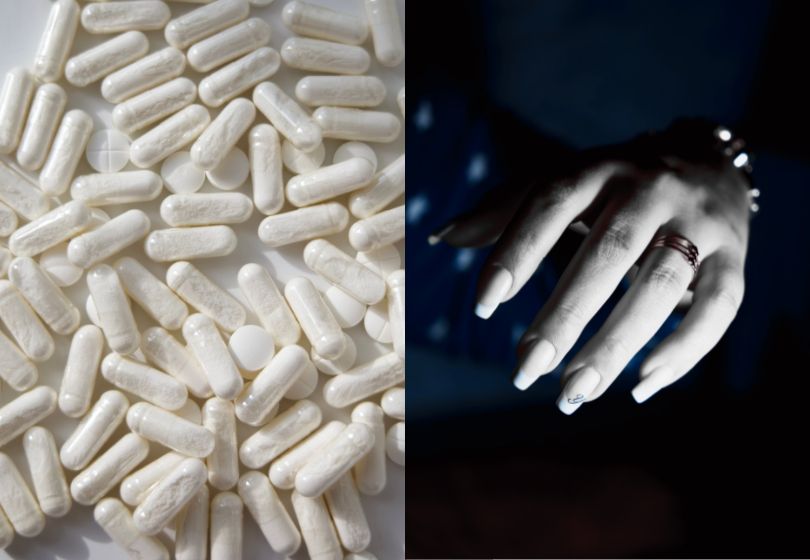
Brittle, splitting nails are common, affecting around one in five people and women more often than men. The instinct is to reach for a supplement, usually biotin. The evidence points somewhere less obvious first: most brittle nails come from external wear rather than a nutritional gap, which shapes what actually helps.
The short answer
For most people, brittle nails are caused by repeated exposure to water, soap, and harsh nail products, along with age and everyday trauma. In those cases, protection and moisture do more than any pill. Supplements have a role in two situations: when a deficiency such as low iron is present, and, more modestly, collagen, which has controlled-trial evidence for stronger nails. Biotin is widely recommended, though its evidence is weaker than its reputation, and it mainly helps people who are deficient.
What actually causes brittle nails
The most common causes are external. Repeated wetting and drying makes the nail expand and contract, which weakens it over time, and soaps, detergents, solvents, nail polish, and frequent manicures accelerate the damage. Age matters too, and the problem is most common in women over 50. A useful clue points to the cause: when fingernails are brittle while toenails stay strong, external factors are the likely reason rather than anything systemic.
Internal causes exist but are less common. The main one is iron deficiency, which can be checked with a blood test for ferritin. Thyroid problems, and shortfalls in zinc or protein, can also contribute. Because these are treatable once identified, brittle nails that are severe, worsening, or paired with other symptoms are worth discussing with a doctor.
The first step: protection and moisture
Because most cases are external, the most effective measures are practical rather than nutritional. Keeping hands out of prolonged water, wearing gloves for washing up and cleaning, limiting harsh nail products and acetone removers, and applying a moisturiser, ideally one with urea or glycerine, to the nails and cuticles all address the actual cause. These steps have a stronger and faster effect than any supplement for the typical brittle nail.
Where collagen fits
Among supplements, collagen has the most direct evidence for nails. In a controlled trial, participants with brittle nails took 2.5 grams of collagen peptides daily for 24 weeks. Nail growth increased by around 12 percent, breakage fell by about 42 percent, and the improvement held for several weeks after stopping. These results appeared without requiring a deficiency, which distinguishes collagen from nutrients that work only by correcting a shortfall. Our guide on collagen for hair and nails covers this in more detail.
Where biotin fits
Biotin is the most recommended nail supplement, though its evidence is weaker than its reputation suggests. The supporting studies used 2.5 milligrams a day and reported improvement, but they were small and lacked a placebo group, so the results are difficult to interpret. Biotin reliably helps only when a genuine deficiency exists, which is uncommon on a normal diet. It also carries a practical issue: at supplement doses it can distort blood tests, including thyroid and heart-attack markers. Our guide on whether biotin works for hair and nails sets out the detail.
Where iron and diet fit
If a blood test shows low iron, correcting it can resolve the nail changes that come with the deficiency, and iron deficiency is the systemic cause most often linked to brittle nails. Beyond a specific deficiency, a varied diet with enough protein supplies what nails need. Supplementing nutrients that are already adequate has little effect on nail strength.
The bottom line
Most brittle nails are a sign of wear rather than a nutritional gap, so the first and most effective response is protection and moisture: fewer harsh exposures, gloves for wet work, and regular moisturising. Supplements help in specific cases. Collagen has controlled evidence for stronger nails and works without a deficiency. Biotin helps mainly when a deficiency is present and comes with a blood-test caution. Iron helps when a test confirms a shortfall. Whatever the approach, nails grow slowly, so improvement takes months of consistency.
Questions people ask
What is the fastest way to fix brittle nails?
Reducing water and chemical exposure and moisturising the nails addresses the most common cause directly, which tends to work faster than a supplement. Results still take weeks, since nails grow slowly.
Does biotin help brittle nails?
It can, mainly in people who are deficient. The studies behind the nail claim were small and uncontrolled, so the evidence is weak, and biotin can interfere with blood tests at supplement doses.
Is collagen or biotin better for nails?
Collagen has the more direct, controlled evidence and works without a deficiency. We compare them in our guide on collagen vs biotin for hair and nails.
Can a deficiency cause brittle nails?
Yes, though it is less common than external causes. Iron deficiency is the most frequent, and it can be checked with a ferritin blood test. Thyroid problems and low zinc or protein can also contribute.
References
Canadian Dermatology Association. Brittle Nails. https://dermatology.ca/public-patients/diseases-conditions/nail-conditions/brittle-nails/
Hexsel D, Zague V, Schunck M, Siega C, Camozzato FO, Oesser S. Oral supplementation with specific bioactive collagen peptides improves nail growth and reduces symptoms of brittle nails. Journal of Cosmetic Dermatology. 2017;16(4):520-526. https://pubmed.ncbi.nlm.nih.gov/28786550/
Pathogenesis, Clinical Signs and Treatment Recommendations in Brittle Nails: A Review. Dermatology and Therapy. 2020;10:15-27. https://link.springer.com/article/10.1007/s13555-019-00338-x
This article is for information only and is not medical advice. Supplements are not meant to diagnose, treat, cure, or prevent any illness. Talk to your doctor before starting anything new, especially if you are pregnant, breastfeeding, or taking medication.

Leave a Reply