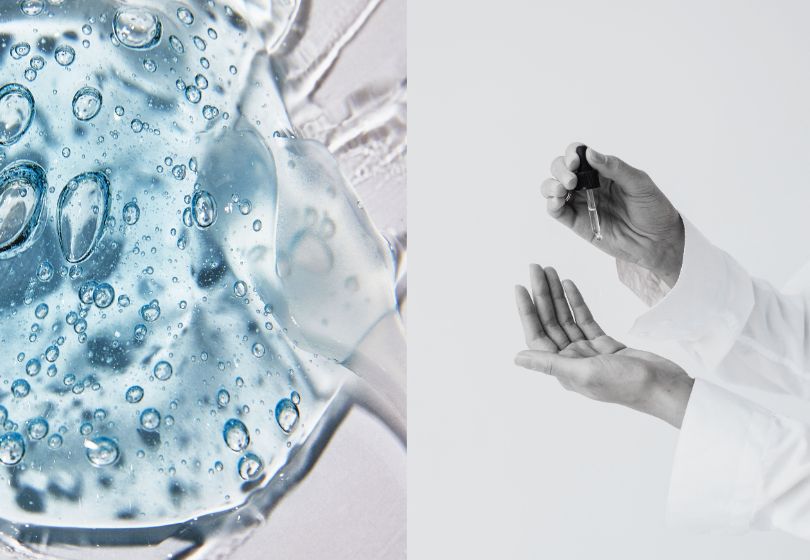
Hyaluronic acid built its name in serums and moisturizers, and now it is in capsules and gummies that promise the same glow from the inside. The pitch makes sense on the surface, since your skin is full of hyaluronic acid and it holds water like a sponge. We looked at whether swallowing it does anything, and the honest answer is more interesting than a simple yes or no.
The short answer
There is real research behind oral hyaluronic acid, and more of it than behind most beauty supplements. Several trials found that taking about 120 milligrams a day for 8 to 12 weeks improved skin hydration, and some also saw softer wrinkles. The catch is that most of these studies were small, ran in narrow groups of people, and the question of how a swallowed molecule reaches your skin is not fully settled. So it is one of the better-supported options on the shelf, with honest limits.
What hyaluronic acid does in skin
Hyaluronic acid is a molecule your body already makes. It sits in the skin and connective tissue and binds water, which keeps skin plump and cushioned. The amount in your skin drops with age, and that loss is part of why older skin looks drier and thinner. That is the logic behind the supplement: top up what time takes away.
What the research shows
This is where oral hyaluronic acid does better than expected. A 2025 review that pooled seven randomized trials found consistent improvements in skin hydration, elasticity, and wrinkle depth from oral supplements. A large 2025 trial in 150 adults, taking 120 milligrams a day for 12 weeks, reported better hydration, a stronger skin barrier, and small improvements in signs of aging. Earlier trials at the same dose found similar results for moisture and fine lines after 8 weeks.
The common thread is dose and time. The studies that worked used roughly 120 milligrams a day, taken consistently for at least 8 weeks. Nothing here happens in a week.
The catch
Two things keep this from being a slam dunk. First, most of these trials were small and run mainly in Asian women, which makes it hard to say the results apply to everyone. The researchers behind the larger 2025 trial pointed this out themselves. Second, there is a real question about how oral hyaluronic acid works at all. It is a very large molecule, and your gut breaks it down before it can be absorbed whole. Animal studies suggest the broken-down pieces are absorbed and some reach the skin, and one idea is that they nudge your body to make more of its own. But the exact path is still being worked out.
In plain terms, the results look real, but the science of why is not finished, and the strongest studies tend to come from the people who sell the ingredient.
The bottom line
Oral hyaluronic acid is one of the more evidence-backed beauty supplements, which is not a high bar, but it clears it. If you want to try it, the dose to look for is around 120 milligrams a day, and you need to give it 8 to 12 weeks before judging. Keep your expectations at the level the studies found, which is better hydration and slightly softer fine lines, not a face lift in a bottle. If dry skin is your main concern, a good moisturizer and a hyaluronic acid serum act on the surface directly and cost less to test. For a fuller routine, our guide on hair, skin and nails supplements covers how the common ingredients stack up, and our guide on collagen looks at the other big skin supplement.
Questions people ask
How much hyaluronic acid should I take for skin?
The trials that showed a benefit used about 120 milligrams a day. More than that has not been shown to work better.
How long until it works?
Give it 8 to 12 weeks of daily use. The studies saw changes in hydration and wrinkles over that window, not sooner.
Is oral or topical hyaluronic acid better?
They work differently. Serums act on the surface where you apply them, while supplements may support skin from within. For dry skin, a serum is the cheaper thing to try first.
Is it safe?
Oral hyaluronic acid is generally well tolerated in studies, with few side effects reported. As with any supplement, talk to your doctor if you are pregnant, breastfeeding, or on medication.
References
Amin P, Sarabi A, Choe S, Scott S, Suh S, Mesinkovska NA. Oral hyaluronic acid supplement: efficacy in skin hydration, elasticity, and wrinkle depth reduction. Journal of Drugs in Dermatology. 2025;24(9):910–919. https://doi.org/10.36849/jdd.8542
Oral sodium hyaluronate improves skin hydration, barrier function and signs of aging: a randomized, double-blind, placebo-controlled trial in 150 healthy adults. Scientific Reports. 2025. https://www.nature.com/articles/s41598-025-32758-5
Oral Hyaluronan Relieves Wrinkles and Improves Dry Skin: A 12-Week Double-Blinded, Placebo-Controlled Study. https://pmc.ncbi.nlm.nih.gov/articles/PMC8308347/
This article is for information only and is not medical advice. Supplements are not meant to diagnose, treat, cure, or prevent any illness. Talk to your doctor before starting anything new, especially if you are pregnant, breastfeeding, or taking medication.

Leave a Reply